
How to Learn Hand Rendering Fast (and Stop Waiting on Renderings Your Client Hasn't Even Seen)
It's Thursday afternoon and you're refreshing your inbox again. The rendering of your client's living room was promised two weeks ago, then last Friday, then early next week, and now your client is texting to ask when she gets to see something. Here's the part that stings: she hasn't seen a single one of your ideas yet, not one, and you've already paid for a polished 3D image of a room she may want to change the moment she looks at it.
If you've sat in that spot, you know how the rest goes. She loves the sofa but wants the windows to feel lighter. She wonders what the fireplace would look like in limestone instead of plaster. Each change goes back to the rendering team, each round costs you money, and each round puts you at the back of their queue again, so the project stalls, the timeline slides, and the thing you outsourced to save time becomes the thing holding your whole project hostage.
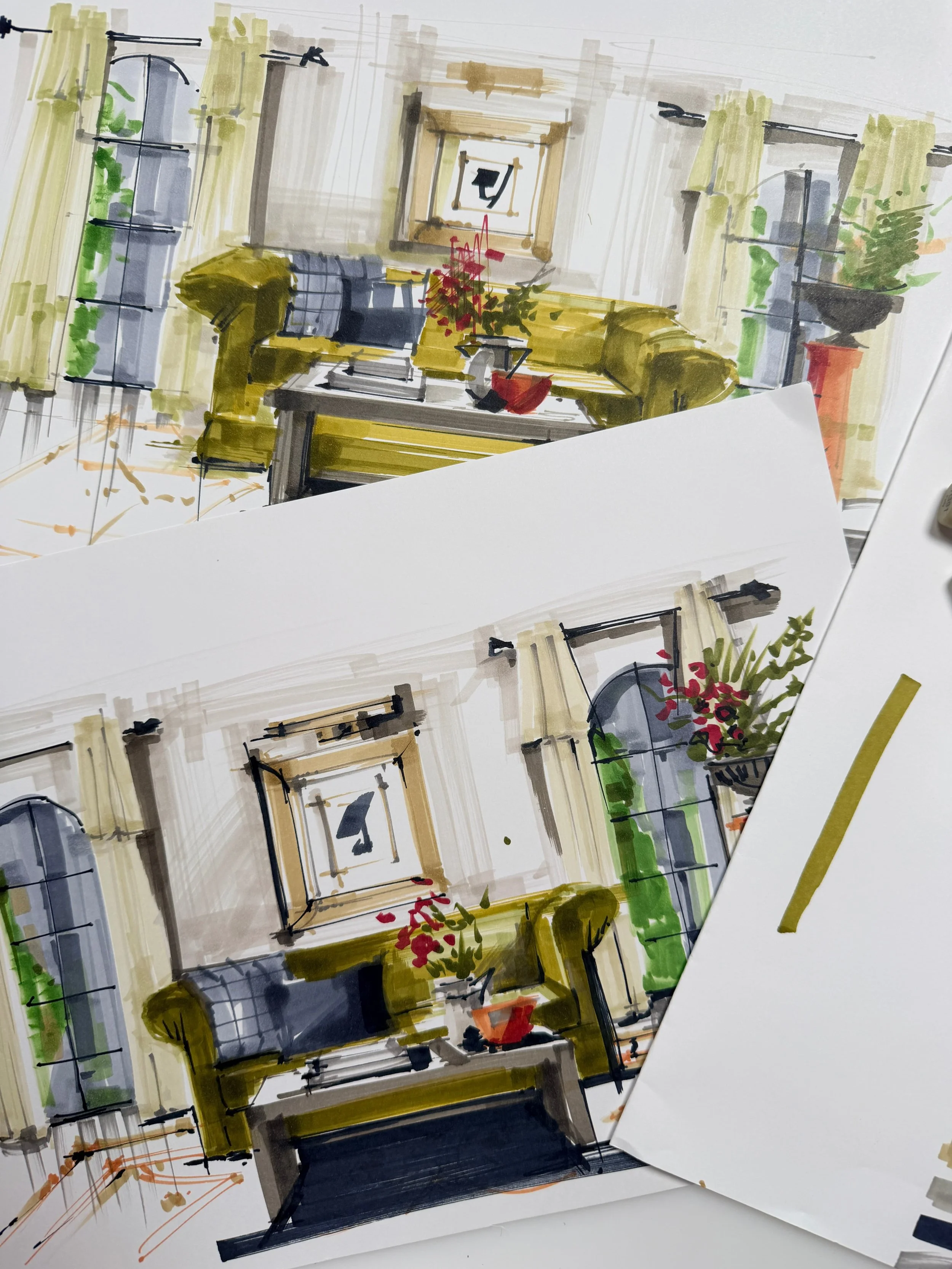
Where perfectionism sneaks into your design process
I teach interior designers to hand render, and the pattern I see most often has nothing to do with talent. It has to do with timing. We reach for perfection at the very first step, the step where the client hasn't even seen our thinking yet, because a polished image feels safer than a loose idea. Tracee Murphy of The Designer Launch describes designers who delay sending a proposal because it "wasn't quite ready," and she puts the fix plainly: "'Done' is often better than 'perfect.'"
That first presentation isn't the moment for a finished picture. It's the moment for a conversation. Susan Knof of KNOF Design draws the line better than anyone I've read: "A rendering is intended to present a solution. A sketch is intended to discover one." When you hand a client a finished 3D image before you've discovered anything together, the revisions aren't a surprise. They're the discovery happening late, on your dime.
What if the answer is simpler than you think?
What if I could offer you a faster way to show clients what's in your head, one that costs nothing per revision and never puts you in anyone's queue? Would you be interested?
Sketching.
Yes, it really is that simple. Long before software and outsourced rendering studios, the sketch was how interior designers communicated, and it worked because it does something a computer image can't. It brings the client into the room with you. The Design Sketchbook says it this way: "A sketch invites your client to co create with you. It is a visual conversation." A polished render tends to get a take it or leave it reaction, and when a client doesn't love part of a finished image, she doesn't lean in. She pulls back.
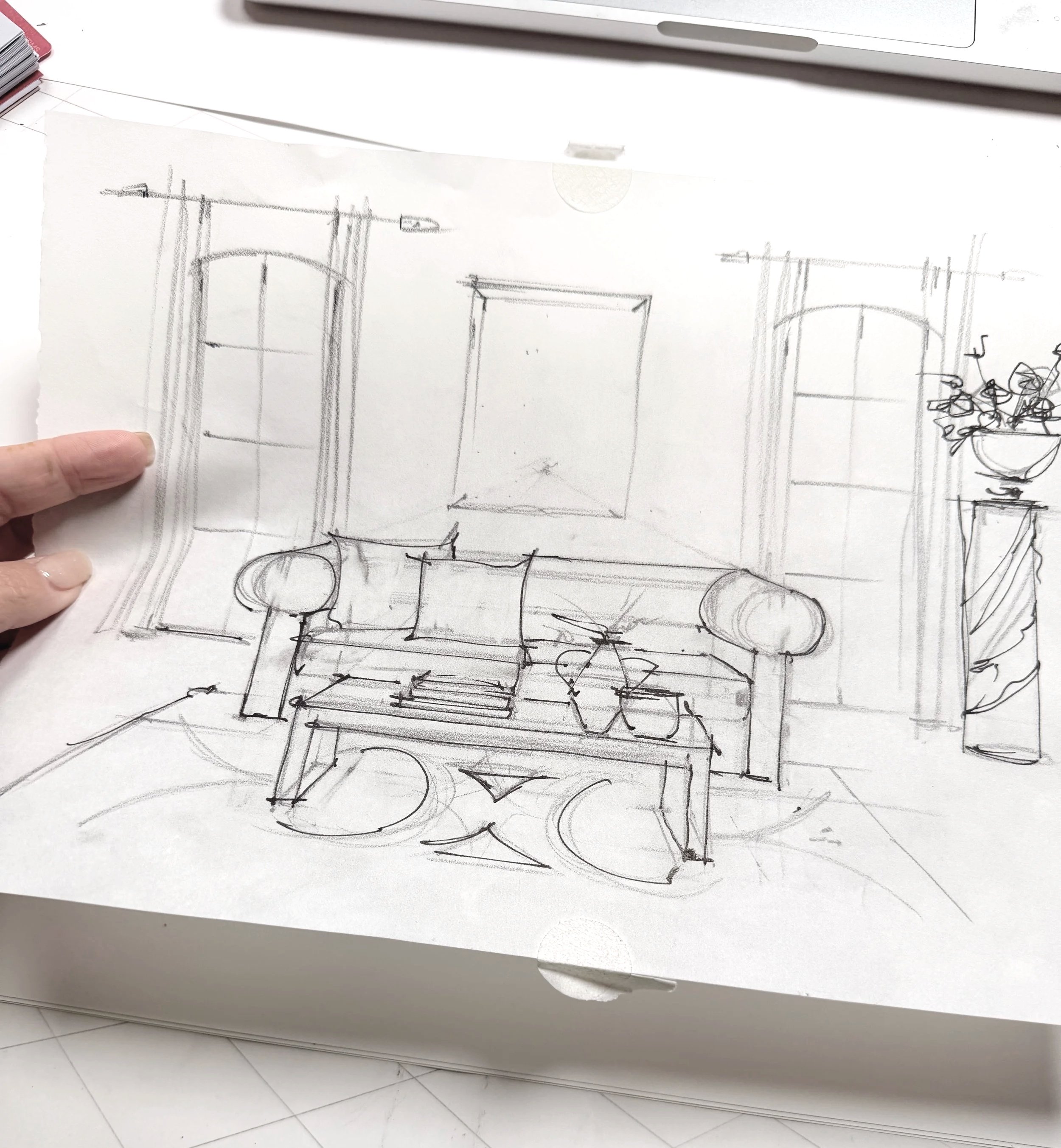
Why sketching sells your design and gets you home by five
Every week you need to show design intent to someone. Sometimes it's your client, sometimes it's the cabinetmaker who has to build the millwork exactly the way you pictured it, and sometimes, honestly, it's you, standing in an empty room deciding whether the island should run the other way. When you can put what's in your head onto paper, you speak the visual language fluently, and designers who speak it fluently close more work.
You don't have to take my word for it. Christopher Grubb of Arch-Interiors Design Group put it in one line: "Hand quality is what is going to make high-end stand out." Seattle designer Jessica Dorling, on why clients need a visual at all: "no matter how much you explain something to a client, things can be lost in translation." And designer Tracy Morris, who still works with a hand watercolorist even as AI tools arrive: "what we do in design is so high touch. There's inherent value in that."
The market is noticing too. In Mattoboard's first State of AI and Interior Design survey, 54 percent of designers said they worry about "homogeneity and diminished originality" as AI images flood the industry. When every rendering starts to look the same, the designer who can pick up a pen in front of a client is the one people remember, and as interior designer Ula Burgiel notes, "there's just a handful of interior designers who can really do it well."
Then there's your time. One industry piece described the solo designer's week as "answering emails between site visits, creating purchase orders late at night, revising drawings after dinner." Another named the feeling I hear from so many of you: a full calendar and a reputation you earned, and "most days, you would still trade all of it for a week where nobody needs anything from you." When you can sketch a revision at your client's kitchen table instead of sending it out and waiting three weeks, those evenings come back. You close the laptop at five and go home to your family.
A designer who reached out to me recently said it better than I could: "We would like to be able to draw our design vision and make it come to life for our clients during presentations." That's the whole goal, in her own words.
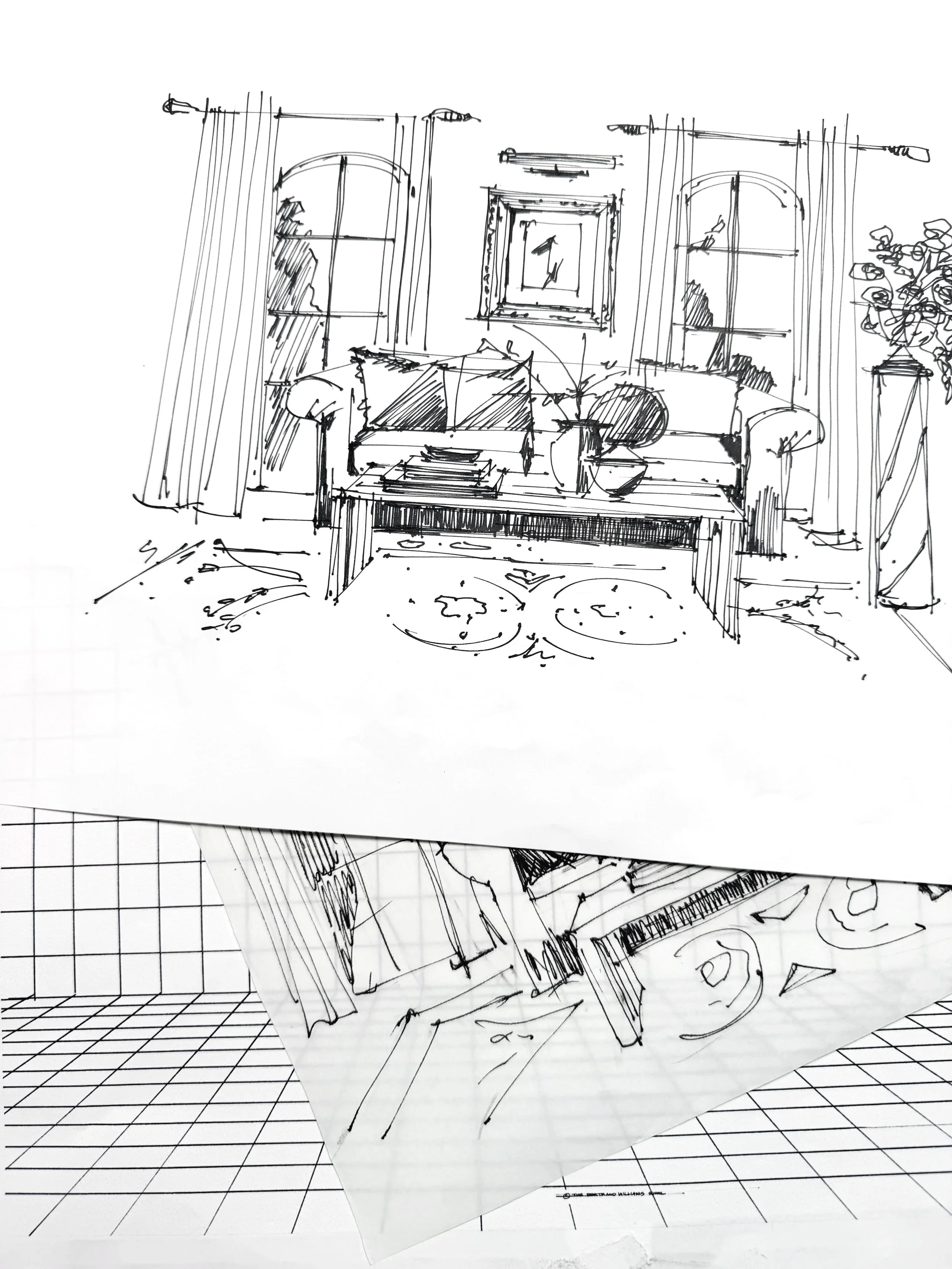
How long does it take to learn hand rendering?
It depends on you of course, but with my teachings and you putting in the practice everyday for for 30 days you will see something in your hand rendering that you love.
Not a second degree, not years of figure drawing, not a natural gift you were either born with or weren't. Thirty days of learning the simple basics and practicing them, and the way you deliver your ideas to clients and sell your services changes for good. Think about what those thirty days buy back: the outsourcing fees on revisions that never needed a 3D image, the weeks spent waiting, the evenings spent redrawing. Wouldn't that be worth a month of your time?
And if a little voice is saying "but I can't draw," I want to hand you a line from The Design Sketchbook that I love: "Your first ugly lines are not proof that you cannot draw; they are proof that you finally started training."
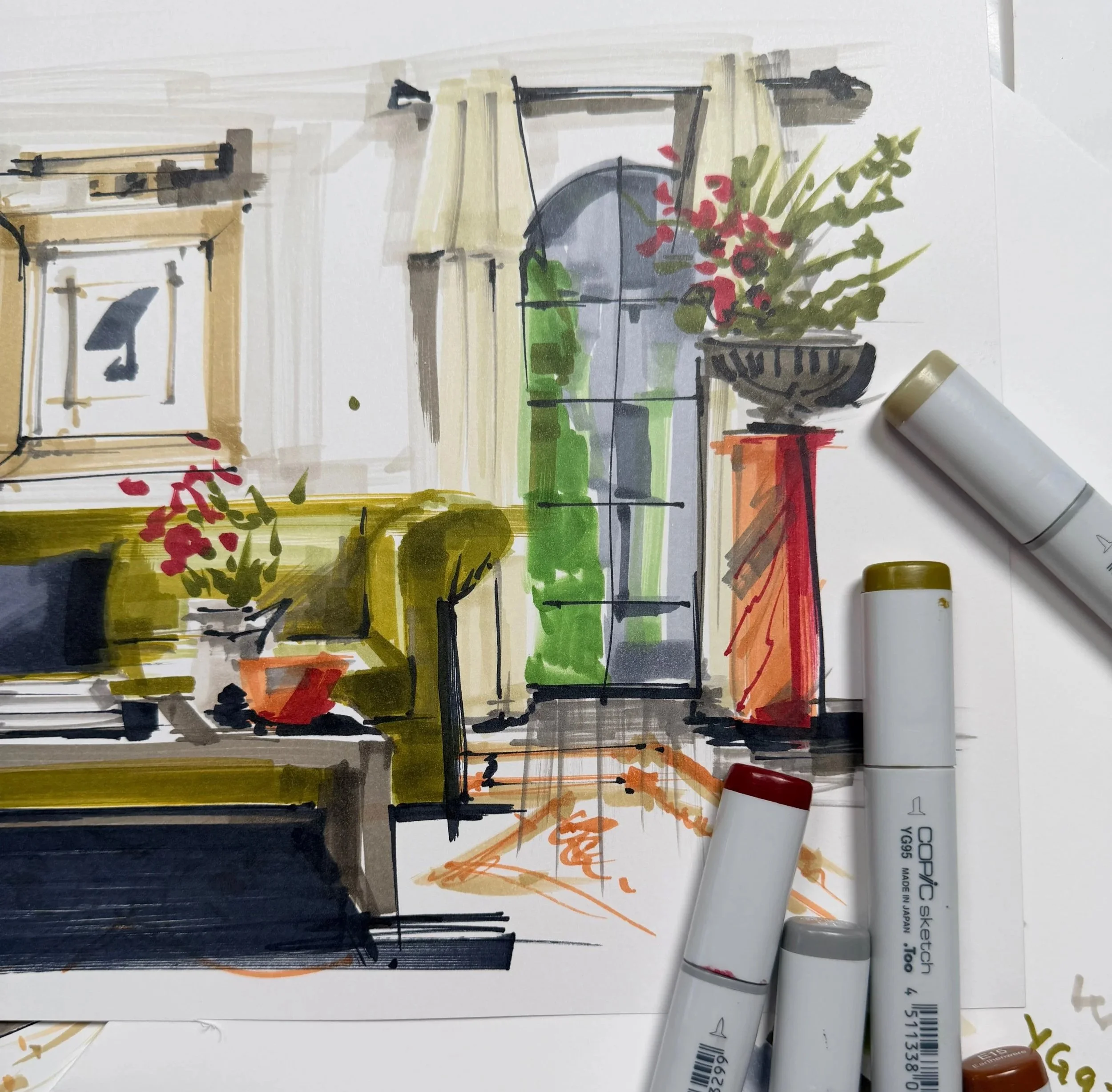
where to start
Start with the simplest step. The Confident Interior Sketch: Sketch to Scale walks you through drawing a room in true proportion, so your sketches read as real spaces your clients can picture themselves standing in. It's the foundation everything else sits on, and it was made for designers who haven't picked up a pencil in years.
When you reach checkout, you'll see the option to add sketching with markers, and I'd encourage you to take it. Rendering with markers is far more achievable than most designers expect, and it's the step where a line drawing becomes something your client can feel: the warmth of the white oak, the afternoon light through the windows, the softness of the linen. Let me show you how easy it really is.
So here's my question for you. The next time a client asks to see something, would you rather send an email and wait three weeks, or pick up a pen and show her right there at the table?
Sketch on,
Shannin
P.S. The Confident Interior Sketch: Sketch to Scale is your first step, and you can add sketching with markers right at checkout.
SOURCES:
The Designer Launch: why interior designers struggle with perfectionism
KNOF Design: why I still begin every luxury interior with a hand sketch
Designers Today: four designers on the future of AI (Christopher Grubb)
Business of Home: will AI put renderers out of business (Jessica Dorling)
Business of Home: designers grapple with the ethics of AI (Tracy Morris)
Elite Design Assistants: a solo interior designer's guide to letting go
Interior Design Community: designer burnout is a business systems problem